Is Your Deck Under Attack? A Homeowner’s Guide to Carpenter Bee Damage and Professional Removal in Nassau County
As the spring sun begins to warm the neighborhoods of Nassau County, from the tree-lined streets of Garden City to the coastal homes of Port Washington, a familiar (and frustrating) sound returns: the persistent, low-frequency hover of the carpenter bee. To the casual observer, they might look like oversized, fuzzy bumble bees enjoying the flowers. But to the seasoned homeowner, they are a flying drill bit aimed directly at your home’s most expensive wooden features.
If you’ve noticed perfectly round holes in your siding, under your eaves, or along your mahogany deck, you aren’t just dealing with a minor nuisance—you’re looking at a structural threat that requires expert carpenter bee removal in Nassau County.
Protect Your Home Today
Don’t let a small hole today become a major repair bill tomorrow. If you’ve spotted drilling activity on your property, the team at Hubert Moore Exterminator is ready to help. With over 50 years of experience serving NYC and Nassau County, we don’t just spray; we provide permanent solutions.
What Are Carpenter Bees? (And Why Do They Love Your House?)
At first glance, it’s easy to mistake a carpenter bee for a common bumble bee. They are similar in size and color, but there is one major physical giveaway: the abdomen. While bumble bees are fuzzy all over, a carpenter bee has a shiny, hairless black abdomen.
Unlike honeybees or wasps, carpenter bees are “solitary” insects. They don’t build massive paper nests or live in social hives. Instead, each female is an independent contractor with a very specific set of tools. Her mission? To bore a hole into “soft” wood—typically redwood, pine, or cypress—to create a gallery for her eggs.
Why Nassau County Homes are Prime Targets
In our region, many of the most beautiful homes feature high-end wood finishes. Whether it’s the decorative trim on a Victorian in Queens or a sprawling cedar deck in Nassau, these structures provide the perfect “softwood” substrate for bees. Unlike termites, carpenter bees don’t actually eat the wood; they simply excavate it, turning your home’s structural integrity into a series of hollowed-out tunnels.
Spotting the Signs: How to Identify an Infestation
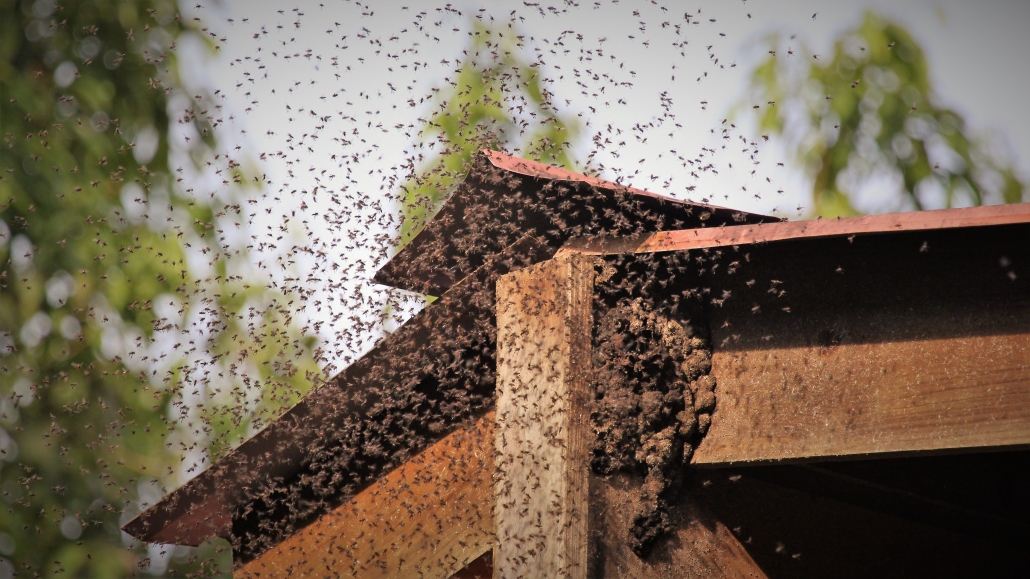
Because carpenter bees are solitary, you won’t see a “swarm.” Instead, you have to look for the evidence they leave behind. If you suspect you need carpenter bee removal in Nassau County, look for these four red flags:
- Perfectly Round Holes: Carpenter bees are master carpenters. They bore holes that are about ½” inch in diameter. If you see a hole that looks like it was made by a power drill, it’s almost certainly a carpenter bee.
- Frass (Sawdust): As the bee bores inward, she pushes the wood pulp out. You will often find small piles of fresh sawdust on the ground directly beneath the entry hole.
- Yellow/Brown Staining: Near the entrance of the tunnels, you may see yellowish-brown streaks. This is the bee’s excrement, and it can permanently stain painted or stained wood surfaces.
- The “Hover” Patrol: Male carpenter bees are highly territorial. While they cannot sting (they don’t even have a stinger!), they will aggressively hover in front of your face if you get too close to their nest site. They are essentially the “bouncers” of the bee world.
The Hidden Danger: It’s Not Just the Bee
Many homeowners ignore a few holes, thinking, “How much damage can one bee do?” The reality is that the bee is only the beginning of the problem. If left untreated, a carpenter bee infestation leads to a “domino effect” of property damage.
1. The Woodpecker Problem
This is the most common reason our animal removal specialists are called to Nassau County homes. Woodpeckers love carpenter bee larvae. To a woodpecker, those 1/2-inch holes are like a “Coming Soon” sign for a buffet. To get to the larvae inside, woodpeckers will use their powerful beaks to shred the surrounding wood, turning a small hole into a jagged, foot-long crater in your siding or trim.
2. Structural Rot and Moisture
The tunnels created by carpenter bees can extend several inches (or even feet) into the wood, often making 90-degree turns to follow the grain. These galleries act as funnels for rainwater. Once moisture gets inside the wood, it sits there, leading to wood rot, mold, and fungus that can weaken the entire structure of your deck or roofline.
3. “Legacy” Infestations
Carpenter bees have a “homing” instinct. If a tunnel is successful one year, new generations of bees will return to it the next. They will often expand the existing tunnels rather than starting new ones, meaning the internal damage grows exponentially every season.
Why DIY Solutions Usually Fall Short
When homeowners see a hole, their first instinct is often to buy a can of spray and a tube of caulk. Unfortunately, this often makes the problem worse.
- Trapped Bees: If you plug a hole while a bee is inside, she won’t just stay there. She will simply bore a new exit hole elsewhere, often through the interior of your home or through a more expensive piece of trim.
- The “Pesticide” Myth: Most over-the-counter sprays only kill the bees they touch directly. They don’t reach the larvae deep inside the gallery, meaning the next generation will emerge regardless of your efforts.
- Lack of Exclusion: Killing the bee is only half the battle. Without professional exclusion services, the wood remains attractive to the next bee that flies by.
The Hubert Moore Difference: Professional Carpenter Bee Removal
At Hubert Moore Exterminator, we’ve been protecting NYC and Nassau County homes since 1970. We understand that effective pest control isn’t just about chemicals—it’s about handiwork and strategy.
Our 3-Step Removal and Prevention Process:
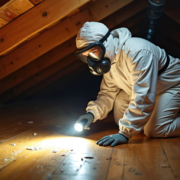
- Comprehensive Inspection: We don’t just look at the holes you’ve found. We inspect the entire “envelope” of your home, including hard-to-reach eaves, peaks, and undersides of decks where bees prefer to hide.
- Targeted Treatment: We use professional-grade residual dusts and sprays that penetrate the entire length of the gallery. This ensures that both the adult bees and the developing larvae are neutralized.
- The “Exclusion” Handiwork: This is what sets us apart. As noted in our Service Overview, we believe in decreasing pesticide usage through physical exclusion. We professionally seal the entry points with materials the bees cannot bore through, and we can advise on the best paints or stains to deter future activity.
Long-Term Prevention: Keeping Your Deck Bee-Free
Once we have successfully completed your carpenter bee removal in Nassau County, there are several steps you can take to keep your property protected:
- Paint vs. Stain: Carpenter bees much prefer bare or stained wood. If you have a recurring problem, consider painting the wood. A thick coat of polyurethane or high-quality exterior paint makes the wood much less appealing for boring.
- Seal the Cracks: Bees are attracted to existing “divots” in wood as a starting point for their tunnels. Using wood putty to smooth out surfaces can prevent them from getting a foothold.
- Regular Inspections: Early spring (late March through May) is the critical window. Catching a bee before she finishes her gallery is the key to preventing the “woodpecker buffet” later in the season.
Trust the Local Experts in Nassau County and NYC
Living in areas like Port Washington, Manhasset, or Queens means dealing with specific local pests that thrive in our coastal and suburban environments. You need a team that knows the local architecture and the specific behavior of New York wildlife.
We aren’t a giant, faceless corporation. We are a second-generation, family-owned business. When you call us, you’re getting decades of experience and a commitment to honest, fair pricing. We take pride in the fact that our customers recommend us for being “cautious, careful, and courteous,” as highlighted in our Customer Reviews.
Whether you are dealing with carpenter bees, bed bugs, or raccoon removal, we have the tools and the “handiwork” approach to solve the problem for good.
Don’t Let the Bees Win This Spring
Your home is likely your largest investment. Don’t let a tiny insect with a big appetite for wood compromise your safety and your property value. If you’ve seen the signs—the holes, the sawdust, or the hovering “guards”—it’s time to call in the professionals.
Hubert Moore Exterminator is licensed, registered, and insured. We offer virtual consultations and rapid response times across Nassau County, Queens, and Manhattan.
Stop the damage before it starts.
Contact Hubert Moore Exterminator Now for an Estimate
Or Call Us Directly: (516) 353-3099
Frequently Asked Questions About Carpenter Bees
Q: Do carpenter bees sting?
A: Only the females have stingers, and they are extremely docile. They will only sting if you physically handle them or step on them. The aggressive bees you see hovering near your face are the males, and they are completely harmless—they’re just all bark and no bite!
Q: How deep do the tunnels go?
A: A single tunnel might only be 6–8 inches deep, but over several years, multiple generations can create a network of “galleries” that extend several feet inside a structural beam.
Q: Can I just paint over the holes?
A: Not effectively. If you paint over a hole without treating the larvae inside, they will simply bore their way out through the new paint once they mature. The gallery must be professionally treated and cleared first.
Q: Are they the same as Termites?
A: No. Termites eat wood for nutrition. Carpenter bees simply use wood as a nursery. However, both can cause significant structural damage over time. Check our Services Page for more info on how we handle both!